

Here are your current grades. These do not reflect the latest quiz.

Tuesday, October 23, 2007
Monday, October 22, 2007
Diction Lesson #4
And now, a return to Voice Lessons.
Consider the following quote:
The man sighed hugely.
- E. Annie Proulx, The Shipping News
1. What does it mean to sigh hugely?
2. How would the meaning of the sentence change is we rewrote it as
The man sighed loudly.
3. Fill in the blank below with an adverb:
The man coughed _____________________.
Your adverb should make the cough express an attitude. For example, the cough could express contempt, desperation, or propriety*. Do not state the attitude. Instead, let the adverb imply it.
propriety - the state of conforming to acceptable rules of behavior.
___________________________________________________
from Dean, Nancy. Voice Lessons: Classroom Activities to Teach Diction, Detail, Imagery, Syntax, and Tone. Maupin House. Gainesville FL, 2000.

Thursday, October 18, 2007
Rime of the Ancient Mariner
Today in class we'll be taking a look at another poem. This is quite the long poem, and it was written by another Romantic and literary critic, Samuel Taylor Coleridge. The poem is very gothic, as are the drawings that accompany this film. Unfortunately, you can't watch this on your own at school, but if you want to watch it again at home, here it goes.
Also, you can find a full text of this book here. This book is part of the public domain. "Mariner" starts on page 1 (I'm pretty sure).
Ozymandias, Percy Bysshe Shelley
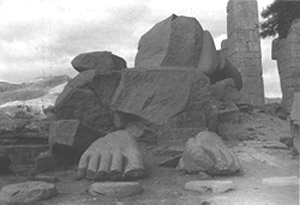
Today we took a look at a poem written by Mary Shelley's brother husband Percy Bysshe Shelley. Here is the worksheet we used in class.
___________________________________________________________
Image taken from http://www.eng.fju.edu.tw/English_Literature/19th_c/Romantic_poetry/Romantic_poetry.htm
Tuesday, October 16, 2007
Gothic and Romantic Literature
Today we will be discussing characteristics of gothic and romantic literature.
For further reading:
Prometheus
Great discussion today. I'll be embedding the short Prometheus videos we watched in class later on today. I think that it's interesting to note the connection between Victor and Prometheus, the monster and Prometheus, and Robert Walton and Prometheus. It's also important to note that this allusion and the use of foils serve to help emphasize Shelley's thematic discussion of the danger of unfettered search for knowledge.
Here are those two videos:
Friday, October 12, 2007
Frankenstein Discussion
Hello folks. Here's the discussion questions for today:
1. Yesterday we talked about foil. What characters could be considered foils for Victor? What could they be emphasizing about Victor's character? Provide evidence/explanation.
2. Victor changes while creating the monster. Describe those changes, and provide a quote or evidence to back it up.
3. Pose your own question about something confusing or something you feel merits more discussion.
Remember, don't feel you have to write a book as a response. Pose your thoughts, back it up, go back and reread what everyone else has to say, and comment from there.
Thursday, October 11, 2007
Why Annotate?
You guys did a great job on our educational video "Why Annotate?". Now your job is to...ahem...annotate your novel. This is something we'll be doing all year, and something you should be doing throughout college, so let's get going.
Hint: Figure out your own personal style. This is not a science. If you like using highlighters, then highlight. If you like brackets, then bracket. Just make sure to jot down shorthand, easily understood margin notes.
Here's that video.
Wednesday, October 10, 2007
Foil

Today we'll be talking about the author's use of characters as foils for the protagonist. Here's the notes we'll be using to guide our discussion.
Wednesday, October 3, 2007
A&P Discussion Area
As you know, I'm not in school today. I'll be back tomorrow, and we are going to start discussing elements related to Frankenstein. I'd really like to give "A&P" some more discussion time. So, while you're at school, and I'm at home, we're going to do a little discussing.
Let's start with three big questions, and we'll see where it goes from there.
- What kind of person is Sammy? How do you know?
- Is the setting of this story important? What is worth commenting on?
- Why did Updike write "A&P"? What was he trying to say about society, the 1960's, or human nature? Post your thoughts, and I'll be responding from 9:20-10.
- Feel free to pose questions to your classmates and myself.
- Mr. Malley
P.S. Oh yeah, click on the comments link right below this post and if you do not have a Google/Blogger account, then post under the anonymous option and put your 1st name last initial after your thoughts.

Thursday, September 27, 2007
Paragraph Organization
Today we'll briefly discuss the organization of this paragraph from the textbook's sample explication essay.
Remember...Say It, Show It, Explain It!
Like many other sonnets, "Design" is divided into two parts. The first eight lines draw a picture centering on the spider, who at first seems almost jolly. It is "dimpled" and "fat" like a baby, or Santa Claus. The spider stands on a wildflower, whose name, "heal-all," seems ironic: a heal-al;l is supposed to cure any disease, but this flower has no power to restore life to the dead moth. (Later, in line ten, we learn that the heal-all used to be blue. Presumably, it has died and become bleached-looking.) IN the second line we discover, tolo, that the spider has hold of another creature, a dead moth. We then see the moth descrived with an odd simile in line three: "Like a white piece of rigid satin cloth." Suddenly, the moth seems not a creature but a piece of fabric--lifeless and dead--and yet "satin" has connotations of beauty. Satin is a luxurious material used in rich formal clothing, such as coronation gowns and brides' dresses. Additionally, there is great accuracy in the word: the smooth and slightly plush surface of satin is like the powder-smooth surface of moths' wings. But this "cloth," rigid and white, could be the lining to Dracula's coffin.
Wednesday, September 26, 2007
Important Due Date Change!
The due date for the explication paper has been changed to Tuesday due to the college fair!
Integrating Quotations
Today we took notes on quotation use. Here's the link to the slideshow. Here's the handout:
Here's the notes for the middle.
Monday, September 24, 2007
Binder Breakdown
Today we will be setting up our binder. Here are the sections you need:
1. Writing Reference
2. Reading Reference
3. Voice Lessons
4. Finished Writing Pieces
5. Quizzes and Tests
Friday, September 21, 2007
Writing Workshop Rules
Here are a few quick and easy rules to help provide an efficient and effective work environment during writing workshop.
- Process is Important Above All Else - Carefully brainstorm. Organize your thoughts. Draft. Revise. Edit. We are here to develop academic habits. I do abide by the logic "don't worry, Mr. Malley. It'll get done." I want the best you are capable of. Always.
- Talking is to be very, very limited - Writing is thinking. Don't put your thoughts into the heads of others while they are trying to write.
- Do Not Shout My Name for Attention - Raise your hand and wait patiently, or if you see I am distracted, walk over to me.
- When we conference, talk in your four inch voice. Maybe six - If you talk in your regular voice, it may disturb someone the thoughts of someone else.
- Computers Are for My Classwork Only - Don't let me catch you viewing sneakers or working on work for another class.
Thursday, September 20, 2007
Word of the Day Feature
We are now responsible for the word of the day on the announcement. Each week I will look for five volunteers to seek out a word from our reading. These words will then serve as the word of the day during the next week's announcements.
I'll have a form for you to record your word. For each word I'll need the following:
- The word.
- The definition of the word as it is used.
- The word in context as it appears in the work.
- The author and work.
- Your name.
- Visionary
- definition: existing only in a vision or imagination
- "All looked colder and darker in that visionary hollow than in reality: and the strange little figure there gazing at me, with a white face and arms specking the gloom..."
- Charlotte Bronte, Jane Eyre
- Francis Peters
Wednesday, September 19, 2007
Did You Know...Explication Rhymes with Rhythm Nation
And that's no coincidence. Here's the assignment sheet, but that's the only help you're going to find here.
Wednesday, September 12, 2007
Explication of Hands
Today I asked you folks to explicate this poem in class. By the end of the period, I need you to have one sheet of paper with the following information:
A one to three sentence explanation of the theme.
A two column chart:
Important Line.............................Its Effect or Significance
____________________________________________________________________
Inside a cave in a narrow canyon near Tassajara
The vault of rock is painted with hands,
A multitude of hands in the twilight, a cloud of men’s palms, no more,
No other picture. There’s no one to say
Whether the brown shy quiet people who are dead intended
Religion or magic, or made their tracings
In the idleness of art; but over the division of years these careful
Signs-manual are now like a sealed message
Saying: “Look: we also were human; we had hands, not paws. All hail
You people with cleverer hands, our supplanters
In the beautiful country: enjoy her a season, her beauty, and come down
And be supplanted; for you also are human.”
______________________________________________
poem reprinted from http://piesenlatierra.wordpress.com/tag/robinson-jeffers/
Note: I've published the chart we finished in class. It can be found here.
Sunday, September 9, 2007
Unit One: Building Blocks
excerpted from Mr. Malley's syllabus...
Unit One – Building Blocks
Approximate # of Weeks: 3
Text(s)
• Selected poems from X.J. Kennedy and Dana Gioia, Literature: An Introduction to Fiction, Poetry, and Drama as well as copies of other poems to supplement. John Updike's A & P.
• Chapters 15, 16 , 17 from Literature: An Introduction to Fiction, Poetry, and Drama covering connotation, imagery, and figurative language and the “Explicating” sections from Chapters 41 & 42
Big Questions/Big Ideas
How do smaller units of meaning (words, syntax, devices) affect the overall meaning (tone, theme)?
Essential Skills – In this unit, students will review/be introduced to basic skills for literary analysis. As the poem is an accessible, self-contained unit of meaning, it’s a good way to start off looking at how the pieces (language, devices) affect the whole (tone, theme, etc.). We will study these small works and eventually build up to Updike’s short story. Students will practice annotating and will write an explication. Writing mini-lessons will be delivered on effectively integrating quotations and logical structuring of evidence and critical commentary.
Assessment
• Nightly annotations
• analytical essay explicating a poem (500 – 750 words)
Thursday, September 6, 2007
Welcome AP!
Writing Prompt: You are in Advanced Placement Literature because you have chosen to be. What has helped you develop an appreciation for literature. What were those factors? Was there an important book(s)? Important people? Momentous experiences? What has made you like books to such a degree that you are willing to do extra work during your senior year for an opportunity to study at an advanced level?
Be truthful, be poignant. We're going to end up making this into a film.
Subscribe to:
Posts (Atom)



